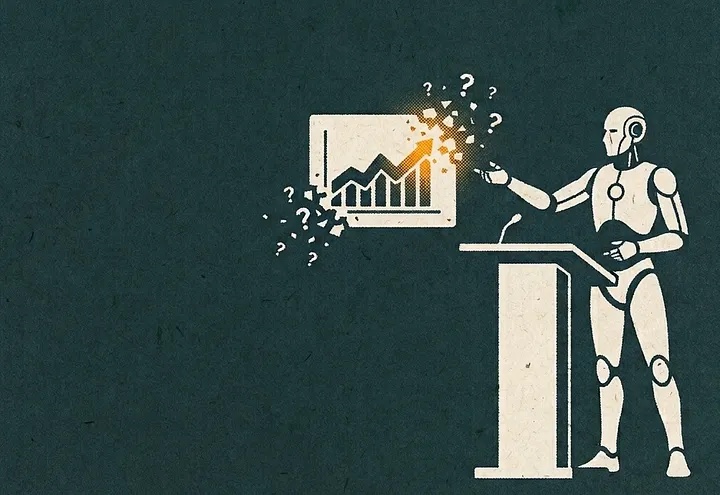
A confident answer can still be wrong. AI can help you draft, investigate and organize your thinking, but important claims still need checking before you use them.
I first wrote about this on Medium in July 2026. The workplace question remains useful: how do you benefit from AI without treating a fluent response as proof?
Why does AI make things up?
A language model generates text using patterns learned during training and the context it receives. That process can produce a plausible answer that contains an invented fact, quotation or reference. These errors are commonly called hallucinations.
In its research on hallucinations, OpenAI describes how training and evaluation can reward guessing rather than acknowledging uncertainty. More capable models can still make factual errors.
What changes when AI can search?
A language model and an assistant with access to search are different things. An assistant may retrieve web pages, read documents or use a calculation tool to help answer a question. Those tools give it information beyond what the model learned during training.
That improves what you can verify, but it doesn’t make every answer dependable. A source can be misunderstood, a quotation can lose its context, or a calculation can use the wrong inputs. OpenAI’s guidance recommends checking important information and visiting the sources directly.
Three habits for checking AI answers
1. Verify the details that matter
Check names, dates, quotations, numbers and references against the original material. For an internal report, that may mean opening the approved spreadsheet or policy and confirming which version the answer used.
2. Open the sources
Ask for sources, then read them. Confirm that each source exists and supports the particular claim. A real link to a reputable organization can still lead to a page that says something different.
3. Keep an owner for the final decision
Decide who reviews the work and what they need to check. Asking a model how confident it feels can start a conversation, but it doesn’t replace independent verification. Review should reflect the consequences of getting the answer wrong.
Make the check part of the workflow
For example, if an AI-generated summary says revenue grew by 12%, find the underlying figures, confirm the reporting period and recalculate the change before sharing it. This is an illustrative check, not a client result.
The useful habit is simple: use AI to move the work forward, then verify the information you’re prepared to put your name on.