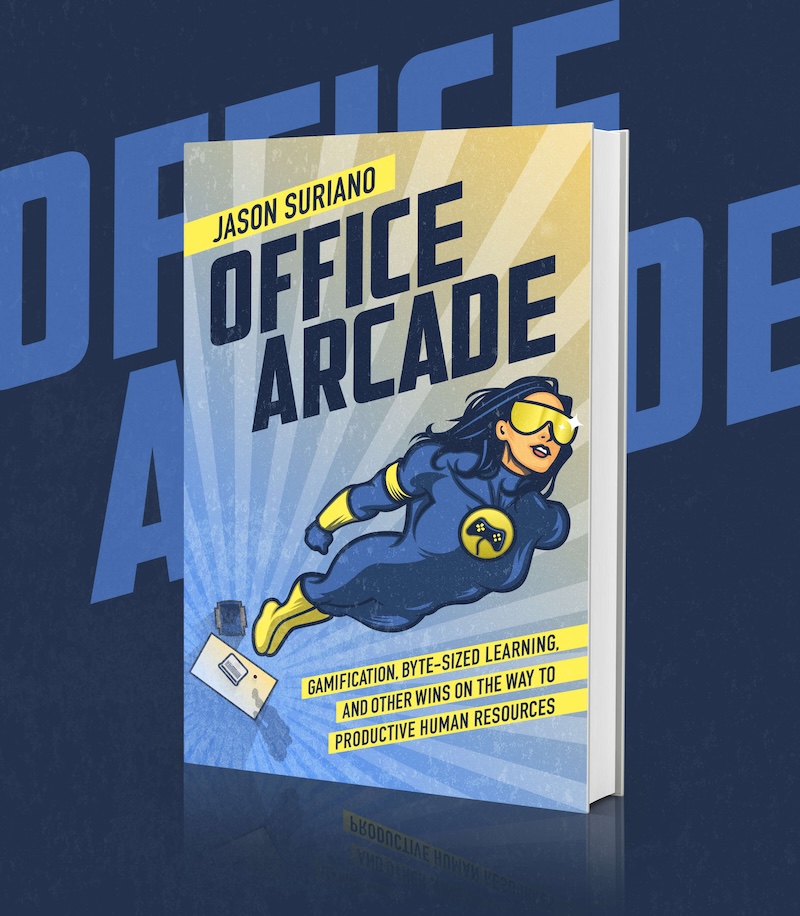
Gamification, Byte-Size Learning, and Other Wins on the Way to Productive Human Resources
What can game design teach us about learning at work?
A practical guide to workplace gamification, employee onboarding and bite-sized learning, drawn from my experience building interactive training products.
Why I wrote Office Arcade, and what still matters today.
A new reflection by Jason Suriano ·
Making workplace learning worth the time
I published Office Arcade in 2017 to put years of work in games, onboarding and training into plain language.
My interest started before the software. Growing up in a family restaurant, I helped train new employees. Making the work more engaging helped people get involved.
Later, the industry kept changing its terminology: edutainment, serious games, gamification. I wanted to explain the thinking behind the work through practical examples, and help readers ask better questions about the learning experiences they were buying or building.
That meant looking beyond points and badges. What does someone need to learn? How will they practise it? What will show that they understand?
INSIDE THE BOOK
Four principles. One learning experience.
The book brings together four principles for designing and assessing workplace learning.
01
Engagement
Give people a reason to participate, with relevant challenges and meaningful interaction.
02
Trajectory
Make the learning pathway clear, so people understand where they are and what comes next.
03
Ubiquity
Consider where and how people learn, including the devices they already use.
04
Data
Use the experience to understand progress and performance, and identify where support is needed.
Who it’s for
Office Arcade is for HR leaders, corporate trainers, instructional designers and people responsible for onboarding or digital learning. It offers a way to think through the experience before choosing a platform or adding game mechanics.
The work behind the book
The book connects to the interactive projects I built with my teams at Rocketfuel and TIQ Software. Those projects brought together learning content, storytelling, software and the practical requirements of the organizations using them.
For a concrete example, explore The Accounted, an accounting education project built around a detective story. It shows how a subject can shape the game itself.
What I take from it today
I now work with leaders on AI readiness, governance and adoption. Looking back at Office Arcade, the connection I see is the attention to the person using the technology.
A new tool gives people something to work with. They also need a clear task, a chance to practise and feedback they can use. Those are useful questions to bring to an AI rollout, just as they are to a training program.
The book reflects the work and technology of 2017. This is my perspective today: start with what people need to do, then design the support that helps them do it.
FROM THE ARCHIVE · AUTHOR HOUR
Hear the original conversation
In this 2017 interview with Charlie Hoehn, I discuss the ideas behind Office Arcade, smaller learning tasks and the work that informed the book.
Jason Suriano is an author, technology entrepreneur and AI speaker based in the Edmonton area. As Director of AI & Data Services at Tantus Solutions Group, he helps enterprise and public sector leaders work through AI readiness, governance and adoption.